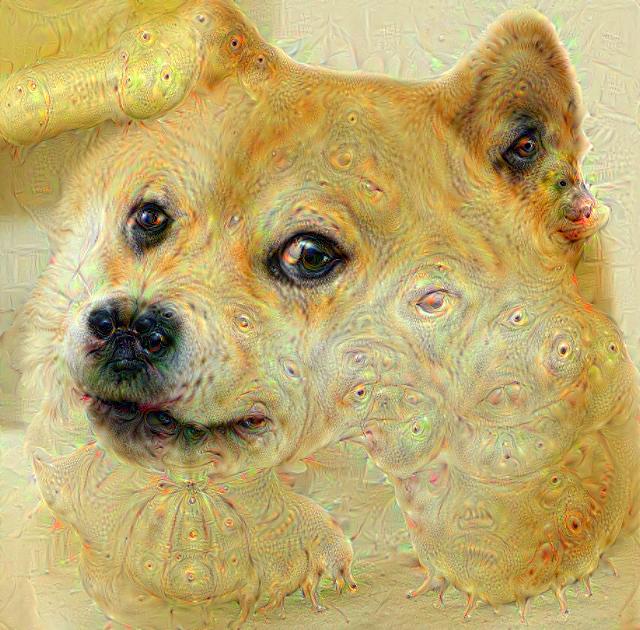
“Artificial Intelligence” has been the buzzword of the day for the past two years or so. AI Art has also seen a huge surge, with (I’d estimate) the majority of Facebook posts now being art (or text) created by AI. There are hundreds of apps and websites where you can create your own complex, legit-looking art, still or video. With Chat GPT, you can now have your every question answered, and your book report or thesis paper written for you.
But today I want to talk specifically about art created via AI. I’ve been experimenting with AI art for about 10 years now.

In 2015, the first website from which you could create artificial art wasn’t much to look at. One of the first projects in this realm was Google’s Deep Dream. Through a website that no longer exists but which you can see on The Internet Archive (as well as recently “created” examples), you could upload a photo and have Deep Dream attempt to “find” what it was trained on (mostly eyeballs and dogs, unfortunately) in your photo. It went viral. Nightmarish though it was, it was the first time a computer had created mainstream art.
The photo above is one of the ones from the archived website. The most fun you could have was to run an image through Deep Dream once, then take that result and feed it back in again. It would then exaggerate the “dream” again and again. For example, someone ran this art by Jasmin Lai through it several times. The crazy thing, it even made something out of nothing. The black bars and the top and bottom of the image were eventually imagined into something by Deep Dream.

I had never seen anything like it. I may have some more examples I did somewhere.
There was also a terrible music video created with the software.
In 2020, I came across a website that was creating actual AI art from scratch. Now THIS was something new. The programs created somewhat-real-looking art from a training dataset of freely available work from the masters.
The hook was that, for under $100, you could purchase a print of the art that they created, but you alone would own, and it would never be produced again.
Sometimes the algorithms appeared to have made mistakes and created their own interpretations of “art.” It was this that interested me, so I purchased a piece called “Dark Stalactites” which hangs on my wall today.

In less than a year, the first websites and apps that allowed YOU to create your OWN AI art came into being, and even, well, kind of, videos — see: Will Smith eating spaghetti. That quickly snowballed and by 2022 we were absolutely inundated with AI art tools. The first tool I used was a website called “Wombo.Art” which is now the Dream AI app and website (which isn’t currently loading images). If I saved anything I generated there I can’t remember.
I soon after started using Wonder.AI’s website (now Wonder web) and eventually their app. They, like many AI art apps, have turned into avatar-designing apps today.
Wonder.AI was fun because you could pick a theme before requesting the description of what the art should look like. I think this made it a little more accessible and pleasing to folks. However, that brought up a lot of issues for artists who didn’t want people making knockoffs of their work… including Simon Stalenhag, one of my favorites.
Midjourney, the most detailed AI Art creator of its time, which had been a private beta, became public in late 2022 and I started creating there as well. Then Chat GPT’s DALL-E2 became available without a waitlist around the same time.
There, I really started creating and getting creative with crafty “prompts” — what you ask the system to produce for you.

Then came DALL-E3, originally integrated into Chat GPT3, but later became a paid product. Microsoft CoPilot also jumped on the scene this year, bringing AI art to the masses for free and business solutions for a cost.
By 2024, believable video art was created by tools like Open AI Sora and Google’s Lumiere, but the tools weren’t yet available for people to create their own, at least off of waitlist, as of this writing — probably a wise decision to slow the release process lest the robots take over. Less high resolution AI text to video tools including one on Canva from Runway are available.